


Peter Herbert - A Life on the Hills 1
Updated: Aug 27
Part One: Where It All Began
From a schoolboy obsession with cars to more than 50 years in motorsport

From road rallying in the 1970s to 23 years campaigning his much-loved Westfield, followed by 14 seasons in a Porsche 911 and now an Alpine A110, Peter has accumulated a wealth of experience and plenty of stories along the way.
Yet his fascination with motorsport began long before he ever sat on a start line.
In the first of our three-part series for HillClimbing.org, Peter takes us back to a childhood obsession with cars, his earliest encounters with motorsport and the journey that eventually led him to the hills where, decades later, he is still competing.

You’ve been involved in motorsport for more than 50 years, across rallying, circuit racing and hillclimbing. Take us right back to the beginning — where did your fascination with competing come from, and what was it about hillclimbing that ultimately kept you coming back?
Having chosen my parents rather carelessly, I failed to come from a motorsporting family. Indeed my father didn’t learn to drive until I was eleven years old. Yet for as long as I can remember I have been obsessed with motor cars, and my fascination with motorsport grew from there.
My first memory of actually witnessing motorsport is of the Monte Carlo Rally sometime during the sixties when I persuaded my father to take me to Scotch Corner, not far from my then Darlington home, to watch the Glasgow starters arriving at a time control. Later I was taken to Catterick Hillclimb on the army ranges above Richmond, and then to a circuit race on Ouston airfield near Newcastle. It was all very exciting for an impressionable schoolboy, and the noise, distinctive smell of Castrol R racing oil and only a rope by way of spectator protection are memories that remain with me.
In the school library among such serious titles as The Economist, The Spectator and National Geographic, I discovered a far more exciting magazine that changed my life. On the green and white cover was a photograph of a red Saab that had just won the Monte Carlo Rally in the hands of Erik Carlsson. This was Motor Sport, and I have a subscription to this day.
With money earned from a paper round I bought every motor magazine I could lay my hands on, including American journal Road and Track. I also collected brochures from local car showrooms, posing as the representative of a potential purchaser, my father - someone who didn’t actually drive.
Motorsport participation also began at school, albeit in a modest way. Being a very proper 400 year old institution, Darlington Queen Elizabeth Grammar School ran afterschool clubs, one of which was an Engineering Society. I and a bunch of likeminded colleagues gradually turned this into an undercover motor club, of which I became secretary. Film shows, playground auto tests and afternoon rallies were held under the supervision of a couple of empathetic masters. Amongst our number was Peter Horbury, later to become a world renown automotive designer for Volvo and Ford.
As final exams approached I informed my careers master that I wished to become a motoring journalist. Unimpressed, he suggested I be a teacher until such time I decided what I really wanted to do. I became neither.
After university and gainful employment I watched a wide range of motorsports until the temptation to take part became too great. Several of my friends rallied, and with their encouragement I began road rallying, a sport that was both accessible and relatively affordable.
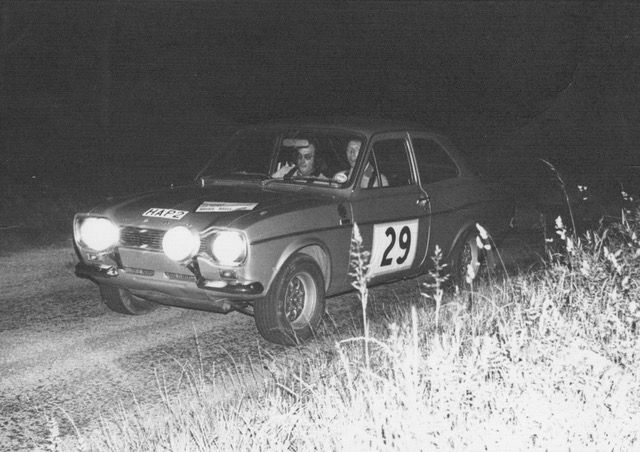
Between 1974 and 1977 I competed in a succession of virtually standard cars that included a VW Beetle, BMW 2002, Ford Escort Mexico and Ford RS2000. The RS was mildly modified with uprated brakes and suspension, additional lights and a roll cage. I won a small rally, came third in a larger one, and enjoyed a few more respectable placings. But the restoration of an old cottage, the first home of my own, brought this chapter to a close which led to a twelve year competition hiatus.
It was not until 1989 that I returned to the fray. After attended the Prescott Hillclimb School and liking what I saw I made an unsteady speed hillclimb debut at Harewood Hillclimb later that Spring at the wheel of a very standard Peugeot 205 GTI.
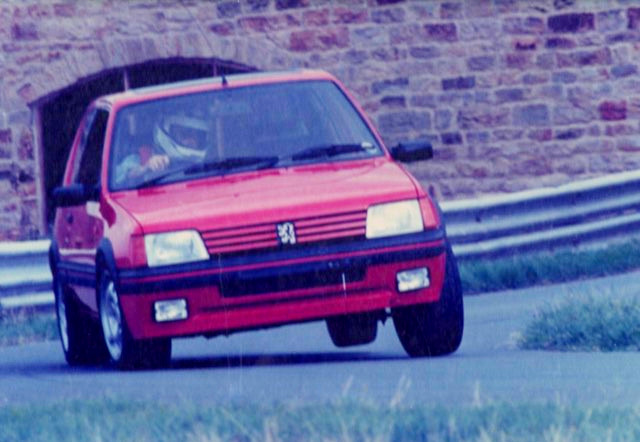
Frank Hall
My first class win came before the end of the season at a Kames sprint in Scotland, and this encouraged me to acquire a full race Westfield for the following season.
I drove that little yellow car for the next 23 years throughout the UK, tended to by legendary spannerman Russ Cockburn. In its final form this 490 kg lightweight was powered by a 190 bhp 1400 cc Cosworth BDH ‘screamer’ that revved to 10,500 rpm, with little happening below six. Many class wins, several records, a Harewood Championship and a handful of British Hillclimb Championship (BHC) points resulted. Yet the largest trophy was for a third place finish.
his came about in 1998 when, in the illustrious company of Graeme Wight Junior, Martin Groves and Tom New I came equal first with maximum points in the British Leaders (now Cup) Hillclimb Championship, the series’ closest ever finish. However, as for family reasons I had missed two rounds, I was demoted to third.

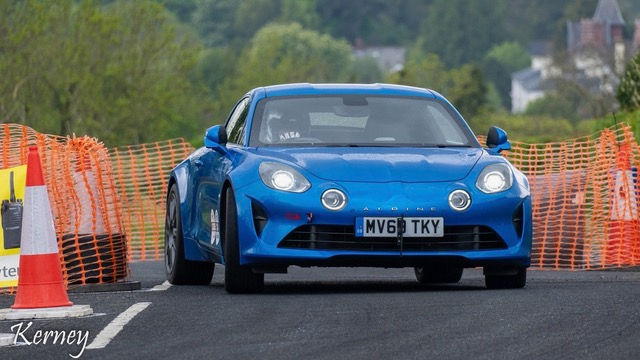
In 2012 the Westfield was replaced by a Porsche 911 that was already twenty years old. Outgunned by more modern machinery, it still remained a front runner amongst other classics. I am now well into my first season with an Alpine A110 which, as with the Porsche, I drive to and from events throughout the UK.
So why do I continue to hillclimb after all these years?
It’s a combination of factors. Of the motorsports I have tried it is the one in which I feel the most comfortable. It has a rich history, charming venues, warm camaraderie among competitors, and attracts a glorious variety of cars. But most importantly hillclimbing remains an amateur sport in the best sense of the term, unspoilt by commercialism and money. Yes there are some big spenders in the paddock, but they don’t flaunt the fact. We are all enthusiasts mixing easily together irrespective of what we drive or the size of budget.
Next week: PART TWO Peter Herbert: The European Adventure.


Comments