


Peter Herbert - A Life on the Hills 2
Part Two: The European Adventure
Mountains, five-mile courses and a very different world of hillclimbing
In Part One of our interview with Peter Herbert, we travelled from his earliest childhood fascination with motorsport through road rallying and eventually to the sport that has kept him coming back for decades, hillclimbing.
For Part Two, we head much further afield.
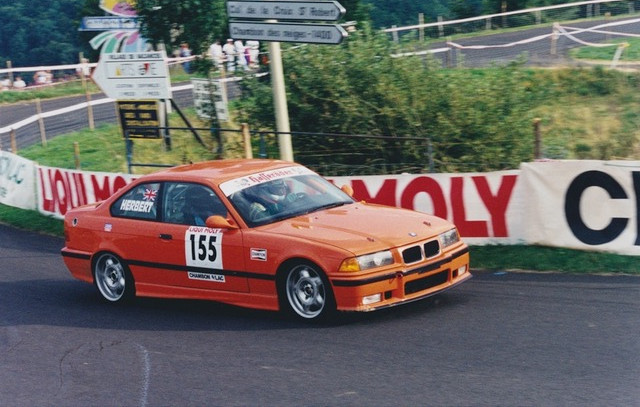
In 2000, Peter registered for the European Hillclimb Championship, hired a Group N BMW M3 and set off with Russ Cockburn to compete on some of Continental Europe’s spectacular mountain courses.
It was a world far removed from British hillclimbing: longer and faster courses, huge crowds, Alpine villages, closed public roads and events that could consume an entire week. Peter competed in Spain, Slovakia, France, Switzerland and Italy, even managing to score European Championship points and claim a class victory at Rieti.
Here, Peter takes up the story of an extraordinary European hillclimbing adventure — and what it was like to be the lone British competitor stepping into a very different motorsport world.
You experienced European hillclimbing at a time when many British competitors knew relatively little about what was happening on the Continental hills. What first took you to Europe, and what do you remember about arriving at those events — the cars, the crowds, the atmosphere and the scale of it compared with British hillclimbing?
In 2000 I registered for the European Hillclimb Championship (EHC) and entered a selection of rounds throughout Continental Europe. Being an international series it was only open to FIA homologated cars, so I rented a Group N BMW M3 from Russ Cockburn, his support at events being an essential part of the deal.
My fascination with Continental hillclimbing began when Autosport magazine reported on the EHC during the 1960s. This was a period when it enjoyed a much higher profile than today with participation by such manufacturers as Abarth, BMW, Ferrari and Porsche. Racing up mountains, through Alpine villages and over closed public roads sounded extraordinary, yet at the time impossibly unattainable.
In pre-internet Britain access to foreign hillclimbs was far from easy. However, by Fax, letter and telephone I made contact with the Swiss EHC coordinator and individual event organisers and then ventured forth on a great adventure into a totally different hillclimbing world.
Each event would occupy a week of our little team’s time. We towed the BMW behind a Volvo estate car full of tools and spares to Spain, Slovakia, France, Switzerland and Italy. It would take two days to get there, two to return, a day of recognisance before the course was closed to the public, a day’s official practice and a day of competition.

The contrast between Continental hillclimbing and that in the UK is of such magnitude that they could almost be two different sports. European mainland hills are longer, wider and considerably faster, with no comfy run-off areas and some very big drops. There are also trees, walls, bridges and buildings to negotiate, and mistakes can be fatal. For a visitor like me it was impossible to learn a track in the way it can be done in the UK, so it seemed wise to drive with a greater safety margin. The inevitable consequence was often being beaten by minutes rather than seconds by seasoned regulars.
To score EHC points it was necessary to finish in the first ten in each Group irrespective of engine size, and set a time within 110% of that Group’s winning time. Remarkably I managed to do this - just.A class win even came my way at Rieti near Rome at the Coppa Bruno Carotti.

Every hillclimb was an immense occasion with a carnival atmosphere fully embraced by the local population. Teams and drivers were also truly international, some with transporters that would have done justice to a Grand Prix paddock. Air ambulances, mobile medical centres and an excitable commentary were also commonplace.
I was inevitably the only British competitor, but was welcomed into this travelling circus, particularly by the Czechs, Germans, Slovakians and Swiss who had some English. The French tended to be more distant, the Spanish indifferent, while the Italians didn’t take well to being beaten in Italy and it was only when a large German intervened on my behalf that the Rieti organisers were persuaded to hand over my trophy.
With courses often as long as five miles, spectators could not line the entire length, but on any significant corner they would be there in considerable numbers, many having camped overnight to secure the best positions. At Monte Jaizkibel in the Spanish Basque Country, my first foreign hillclimb, a then motor racing starved nation flocked to the course. This resulted in some extreme spectating, not dissimilar to that seen on Alpe d’Huez during the Tour de France as crowds actually stood on the track, parting only when a car was virtually upon them. This took some adjusting to.

Next Week : Part 3 - Peter Herbert: Why We Keep Coming Back
Cars change. Times get faster. But some things about hillclimbing endure.


Comments